GATING DESIGN WIZARD FOR HPDC

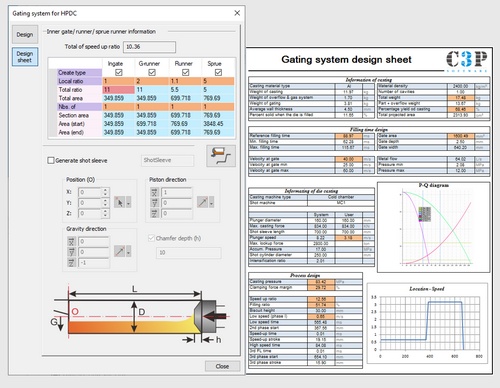
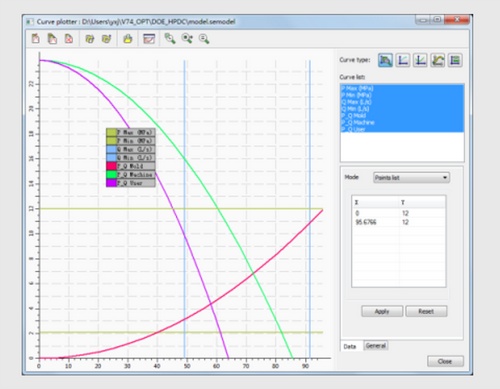
The HPDC Gating Design Wizard simplifies gating design by allowing users to input casting details like weight, projected area, material, shot machine, and biscuit size. It generates a PQ graph to verify the shot machine's capability, and provides key results like filling time, ingate velocity, required ingate area, and phase velocities and shift times. The wizard also calculates casting pressure, clamping force margins, and runner cross-sections for use in Smart Runner Design. This streamlined process ensures an efficient, accurate, and quick gating design, reducing the time and effort required for setup.

DESIGN TOOLS AVAILABLE IN CAST-DESIGNER FOR HPDC

These tools help designers quickly calculate different aspects of HPDC gating design:

Predefined gating library
Predefined standard library of casting accessories
Shot machine tonnage calculation tool
Shot machine database: cold & hot
Casting wall thickness analysis tool
Casting zone analysis
Shot sleeve model generator
Velocity curve generator
Overflow design tools
Cooling calculators and design tool
Venting calculators and design tool
Projected area calculator
Cooling calculator
Venting / overflow calculator
Gate velocity advisor
Fill time advisor
HPDC Design Tools - QuickCAST Flow Simulation

QUICKCAST FLOW SIMULATION

HPDC INNER GATE DESIGN

To create an ingate, simply define:

You can define as many ingates as needed. This is sufficient for flow simulation in QuickCast. Once set, users can easily visualize the flow pattern through these ingates.

QUICKCAST FLOW SIMULATION

Choosing the correct part orientation and selecting ingate locations are critical tasks in gating system design, especially during new product development. These decisions require skill and experience, often involving multiple iterations and significant time and cost in flow simulations or trial die designs.

QuickCAST, part of the Cast-Designer suite, provides metal flow simulations in just a few minutes.

It delivers key results, including:

Simulations for a 1-million mesh model take less than 5 minutes, saving engineers valuable time.

The fast and insightful results enable engineers to experiment with different gating methods and ingate locations, optimizing the filling process without the need for numerous full-scale flow simulations. This reduces the number of iterations required, ultimately saving time and costs.

QUICKCAST OPTIMIZATION

The QuickCAST Optimization Tool allows casting designers to fine-tune ingate locations and sizes to achieve optimal results, such as balancing the flow of liquid metal within the casting.

Two methods are available: DOE (Design of Experiments) manual, or automatic. The tool runs multiple iterations of QuickCAST flow simulations until the desired result is achieved.

Users can set guidelines for ingate adjustments, including minimum and maximum sizes, flow volume, and flow length as criteria for optimization.

COMPARISON OF QUICKCAST FLOW vs CFD FLOW

QuickCAST Results

QuickCAST delivers results in just a few minutes by considering only the geometry of the casting. The results are 80% to 90% comparable to those of full-scale CFD flow simulations.

Use it during initial design stage iterations

QuickCAST 1 QuickCAST 2

CFD Flow Results

CFD simulations take hours to produce accurate flow results by accounting for factors such as temperature, velocity, surface tension, viscosity, and friction. While more accurate and realistic, CFD is typically used for final evaluation of gating for flow results.

CFD 1 CFD 2
HPDC Design Tools - 3D Gating & Smart Runner

DESIGN TOOLS FOR HPDC

3D GATING & SMART RUNNER DESIGN

SmartRunner is a breakthrough self-learning AI technology in Cast-Designer. With Smart runner, the system can generate the gating system in a semi-automatic way. The user only needs define the biscuit size and position, also provides the guideline link information, then the system will generate the gating system automatically.

It's as easy as drawing on a paper

SMART RUNNER TO GENERATE GATING

After completing Gating wizard page and ingate design, now it's time to create runners. Ingate locations and sizes are already defined and optimized, now just add sprue/biscuit location and connect ingates to the sprue/biscuit through smart runners. Smart runner gating design tools has intelligence about the standard definition of different runner shapes.

Auto Runner - Mid Line

1 Auto Runner – Mid Line

Place Sprue. To create runner, select an ingate (created in previous step) and pick a point towards sprue, runner automatically created as per width of the ingate size.

Auto Runner - More Line

2 Auto Runner – More Line

Select other ingates and points of the desired location of the runner on screen, runner automatically created with correct width, draft, height as required for the ingate.

Auto Runner in 3D

3 Auto Runner in 3D

View runners in 3D, runner section width and height gradually reduced with proper draft angle. Each runner width is as per the width required for the ingate.

Auto Merge Runners

4 Auto Merge Runners

Select 1st runner as master and select 2nd to merge, runner section of the 1st runner automatically adjusted where 2nd runner is merging. Similarly in the other side runners.

Sample Gating Designs

HPDC Design Tools - Complex 3D Runner Generation

COMPLEX 3D RUNNER GENERATION USING 3D PROJECTION

Even if for complex 3D runner system, the Cast-Designer system can handle it easily. Define the workspace and create the 3D die face and addendum in ParaCAD, the build-in CAD system. Using 3D runner projection function to get the CAD based 3D runner system.

3D die face design

1 3D die face design (ParaCAD)

Gating system design

2 Design gating system in a workspace (SmartRunner)

Runner system plan

3 Designed runner system in a workspace (plan)

CAD 3D runner

4 Final: Projected CAD base 3D runner

3D Inner Gate Features

Features like inner gates also modified to match the parting line surface

Generated 3D inner gate
The generated 3D inner gate
Generated 3D inner gate
The generated 3D inner gate
User modified 3D inner gate
User Modified 3D inner gate
CAD quality fillet rounds

Sample 3D Gating Designs

HPDC Design Tools - Overflow, Venting & Shot Sleeve

OVERFLOW & VENTING DESIGN

Adjustable Overflow Size

Adjust the overflow size by simple parameter and fully linked.

Flexible Display

Flexible display and hidden/show button.

WYSIWYG Design

What You See What You Get style design.

Complex Shapes

Complex overflow shape creation capabilities.

Free Style Method

Overflow could be designed in free style method, flexible operation and easy location.

Property Copy

Easy to copy the properties of overflow.

Detailed Modification

Detail modification for overflow, fully parametric.

User Database

Support user's database of preferred configurations.

Pre-defined Types

Build-in pre-defined overflow type and parametric.

Overflow placement
Overflow placement
Overflow in 3D
Overflow in 3D
Property Editor
Property Editor
Property Editor
Overflow Types

VENTING DESIGN

And the venting block design, could be done in full parametric, also to support vacuum system.

Venting Design UI
Venting Design UI
Venting Block added to casting

SHOT SLEEVE DESIGN

SHOT SLEEVE MODEL

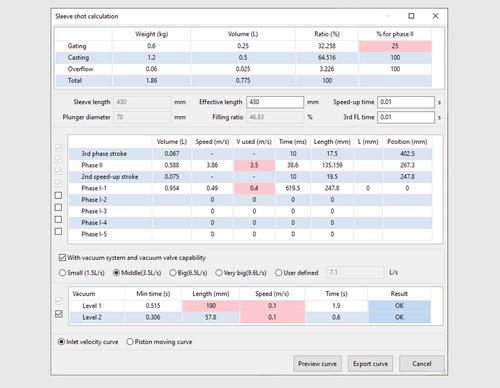
Include Shot Sleeve into your simulation model

📊 Precision Simulation
  • Matches actual machine behavior
  • Replicates true piston acceleration
  • 90%+ realistic melt flow prediction
🔍 Defect Prevention
  • Accurate air entrapment forecast
  • Early cold flakes detection
  • 40% porosity risk reduction
⚙️ Process Optimization
  • Virtual shot profile tuning
  • Machine capability evaluation
  • Optimal gate velocity calculation
💰 Cost Reduction
  • 60% fewer machine trials
  • Lower scrap rates
  • Faster production ramp-up
🏭 Equipment Specific
  • Machine-specific modeling
  • Hydraulic response included
  • Real sleeve friction effects
🛠️ Die Design
  • Optimized overflow systems
  • Precise biscuit dimensions
  • Better thermal management

SHOT SLEEVE MODEL EXAMPLES

Shot sleeve UI
Shot sleeve UI
Casting with Shot sleeve
Shot sleeve UI
ShotSleeve Flow 1
Casting with Shot sleeve
ShotSleeve Flow 2
HPDC Design Tools - Fast Cooling Analysis

FAST COOLING ANALYSIS

The cooling system is key to controlling solidification, reducing shrinkage porosity, and minimizing stress and distortion in your castings. A well-designed cooling system directly impacts die life and production rates.

Cast-Designer introduces a revolutionary approach to cooling system design and analysis, SmartCooling Design and FastCooling Analysis to quickly assess design performance.

Results are generated in just a few minutes, enabling rapid validation of your design.

OPTIMIZE COOLING SYSTEM DESIGN WITH CAST-DESIGNER

Traditional Approach

In traditional casting simulation, die thermal balance is analyzed and optimized through a complex and time-consuming Full-Mould Cyclic Flow and Solidification Simulation, which requires:

  • Complete mold geometry
  • Accurate heat transfer coefficient (HTC) values
  • Complex setup
  • Hours to days of computation time

Fast Cooling Feature

During the design stage, engineers can use Cast-Designer's Fast Cooling Feature. This geometry-based mass-thermal cooling analyzer simplifies the process by:

  • Using only casting geometry
  • Requiring only cooling channel geometry
  • Minimal setup requirements
  • Minutes to generate results
1 Find Mass Distribution 5 min
Mass Distribution Analysis

EMDI: Extracts the Mass Distribution Index of the part

EMDI thickness is mapped on the 3D part surface and displayed in a color contour.

The system will generate a smooth background mesh automatically.

A smaller cell size can get more accurate result but need more CPU time and resources for display.

2 Fast Cooling % 3 min
Fast Cooling Analysis

Cooling Affection: Select the cooling channels for analysis

Run the fast cooling analysis – takes 3 minutes

Fast Cooling analysis considers the heat affection of the channels to the SURFACE of casting part using inverse method

Displays results in color contour

The cooling affection formula could be customized

3 Cooling Affection 2 min
Cooling Affection Result

Fast Cooling Analysis on EMDI & Cooling Affection on the Casting part: Combine both the EMDI and fast cooling result together to get the cooling affection result.

Now, cooling affection with respect to mass of the component is displayed in color contour, which is more accurate than surface level analysis.

HPDC Design Tools - Smart Cooling AI

ARTIFICIAL INTELLIGENCE TOOLS: SMART COOLING

AUTOMATIC COOLING CHANNEL DESIGN

SmartCooling automates the critical die casting cooling design process using a 3-step approach that ensures a comprehensive and optimized cooling system. This method accelerates the cooling design process, increasing speed by 10 to 30 times.

Complete cooling system design in minutes instead of hours or days
1 Define Cooling Regions & Material
Cooling Regions Setup

Based on the metal flow path, the system or user assigns regions to the casting system, supporting up to six main regions and 24 sub-regions.

The casting volume and projection area are distributed across these sub-regions.

Users input the casting and mold material, production rate, and cooling channel properties to complete the setup.

2 Automatic Generation of Cooling Channels
Auto Generate Cooling

By assigning different cooling channel properties, such as standard or jet cooling.

The system predicts the optimal cooling system and automatically generates a fully parametric cooling channel geometry and layout design.

This is the core technology behind SmartCooling intelligence.

3 Optimize Cooling Channels using FastCooling Analysis
Optimize Cooling

Check the effectiveness of the cooling channel design using the FastCooling Analysis feature.

Users can make modifications to the cooling channel design, and any adjustments to location or cooling power will be immediately reflected in the FastCooling analysis, providing real-time feedback.

Smart Cooling Examples: Giga Casting Part

Cooling design for Giga is time consuming and huge numbers of cooling difficult to manage because of its large numbers, Cast-Designer provides complete tools to auto create, manual adjustment, group wise management.

SmartCooling UI Features

Excel-style Editing

All parameters listed in a datasheet with Excel-like editing capabilities including center coordinates, line direction, length, diameter, and flow rate.

Advanced Filtering

Region, sub-region, and location filters help quickly find related cooling channels.

Batch Operations

Align function enables batch property editing. Batch rename maintains naming consistency after modifications.

Mirror & Update

Mirror channels to opposite mold halves and update projections after adjustments.

Visualization

Contour displays show X/Y/Z coordinates to verify channel locations.

CAD Integration

Generate cooling channels and region boxes directly to CAD environment.

HPDC Design Tools - Die Cooling Spray Simulation

ADVANCED DESIGN TOOLS FOR HPDC

DIE COOLING: SPRAY SIMULATION

Die-spray is a critical yet often overlooked process in die casting. Improper or uneven die-spray can cause rapid cooling that affect casting quality, and mainly damages delicate die areas, which may result in frequent repairs, maintenance, or replacement — ultimately halting production.

A well-designed die-spray system directly impacts die life and production rates.

Cast-Designer's advanced die-spray model enables users to simulate every aspect of die preparation. This includes considering the mold surface shape, die temperature, as well as the position and movement of spray nozzles, open and close time of different spray nozzles. It ensures optimal cooling distribution and prolongs die life while maintaining production efficiency.

The dynamic heat transfer coefficient (HTC) derived from this simulation can be used in the most accurate Full-Mould Cyclic Flow-Solidification Simulation, enhancing the overall simulation precision.


Die-Cooling Spray Design and Simulation Process

Die-Cooling UI
Die-Cooling Spray Interface
Die-Cooling UI
Nozzle Configuration
Die-Cooling UI
Die-Cooling Spray Interface
Die-Cooling UI
Nozzle Configuration

Mould Configuration

  • Define mould opening distance and direction
  • Support different mould types (fixed/movable)
  • Handle slider attachments
  • Support multiple objects
  • Define general spray lead time

Nozzle Setup Options

  • Head plate working plane and size
  • Multi-nozzle quick setup tool
  • Horizon/vertical row configuration
  • Reference height and standard HTC
  • Vertical/shadow area factors
  • Excel/CSV import capability

Example: Die-Cooling Spray Design

Results Comparison

There are two design plans for advance spraying. One is no nozzles on the main runner region and another one was three nozzles on the main runner region. The lead time of spraying was 5 seconds only and the whole simulation was 10 seconds.

The result of 4.51 second shows the different of temperature distribution of the vertical region and this affection is continue until the end of the simulation.

Plan A: No Nozzles on Main Runner

Plan A Result 1
Plan A Result 2
Plan A Result 3
Plan A Result 4

Plan B: Three Nozzles on Main Runner

Plan B Result 1
Plan B Result 2
Plan B Result 3
Plan B Result 4

Temperature distribution on the die surface during the complete casting cycle

HPDC Design Tools - Cooling Channel Flow Simulation

ADVANCED DESIGN TOOLS FOR HPDC

COOLING CHANNEL FLOW SIMULATION

In complex cooling systems, media flow within the channels can be quite intricate. Performing a thermal and flow simulation provides a detailed examination of both the media flow and temperature distribution. Furthermore, the dynamic heat transfer coefficient (HTC) can be derived from the results of the simulation, which can be used in the most accurate Full-Mould Cyclic Flow-Solidification Simulation.

Entry and Exit points
Entry and Exit points for cooling media
Cooling media properties
Define cooling media properties, velocity, initial temperature etc

Example: Media Flow in Cooling Channel

Dynamic HTC values
Dynamic HTC values over time
Dynamic velocity vs time
HPDC Design Tools - Part Ejection Simulation

PART EJECTION SIMULATION

The quality of parts produced by die casting may be affected during the ejection stage of the molding cycle. At this stage, the parts are mechanically forced to separate from the molding surfaces. The ejection force depends on the shrinkage of the metal alloy onto the core and on the friction properties of the contacting surfaces at the moment of extraction.

Ejection takes place in a very short time; hence the static coefficient of friction must be considered for modelling the ejection process.

Example: Part Ejection Simulation

1 Full Mould Stress Simulation

Perform a full mould stress simulation: Solidification + Stress simulation, full mould or solid shell model, take account the contact pressure.

2 Couple to Cast-Works/CDPE

For ejection process simulation. The following result will be taken: ejection time, casting temperature, residual stress of casting and contact pressure of casting.

Casting with Die Set

Casting with Die Set

Complete assembly view showing casting within die components

Die & Casting temperature

Die & Casting Temperature

Thermal profile during ejection process

Ejection pin locations

Ejection Pin Locations

Strategic placement of ejection mechanism components

Distortion in casting

Distortion Analysis

Deformation caused by ejection pin forces